Litigation Is Like Beyoncé at a Wedding: Ignore It and It Still Steals the Show

by Rebecca Side
I’ve spent over 20 years in the claims world, which means I’ve lived through:
The rise and fall of shared drives
The false promise of “FINAL_v7_reallyFINAL.xlsx”
So, when I hear “We’ve already digitized claims,” I usually smile… and then ask one follow-up question:
“Cool. How are you managing litigation?”
That’s usually where the conversation gets awkward.

Because while the market has been busy modernizing FNOL, bordereaux, and straight-through processing, litigation, the bit that quietly eats 30–50% of total claim cost, is still being managed via emails, PDFs, and institutional optimism.
And optimism, as we all know, is not a control framework.
The Problem Isn’t Technology Fatigue. It’s Selective Modernization.
There’s a narrative I hear a lot:
“We don’t want another system.”
“Litigation is complex.”
“Our panel firms handle it.”
All fair points. Also… all slightly beside the point.
Because this isn’t about adding more tech.
It’s about addressing the one part of the claim lifecycle where:
Costs escalate fastest
Decisions compound quietly
And visibility tends to vanish the moment counsel is appointed
In our Bridging the Gap study (with Fell Consulting):
72% of adjusters said they feel “in the dark” once a claim goes legal
61% of attorneys said they don’t receive clear resolution strategies

That’s not a tooling issue.
That’s a structural one.
It’s a bit like organizing a very expensive wedding… and then letting the catering, music, and guest list sort themselves out “off-platform.”
(We’ve all seen how that ends. Usually on TikTok.)
Litigation Is Where the Story Changes. And So Does the Spend
If you’ve watched any high-profile legal story unfold lately, from celebrity defamation cases to social-media-fueled class actions, you’ll notice a pattern:
Once litigation starts, narrative matters.
Momentum matters.
Behaviour matters.
RAND’s latest social inflation research backs this up:
Trial awards are increasing at 7.6% annually
Awards over $5M have nearly doubled in the past decade

And yet, most litigation management still relies on:
Retrospective reporting
Free-text updates
And billing reviews that arrive after the strategic decisions are already baked in
That’s like reviewing the receipt after the party, instead of deciding how wild the party should get in the first place.
What We’ve Learned From the Data (and 2025 Was Loud)
At ClaimDeck, 2025 wasn’t about theory. It was about proof.
From our 2025 data-driven wrap-up:
Clients saw material reductions in case life
Litigation workflows became measurably more consistent
Engagement improved, not because people were “forced” to use a platform, but because expectations were finally clear
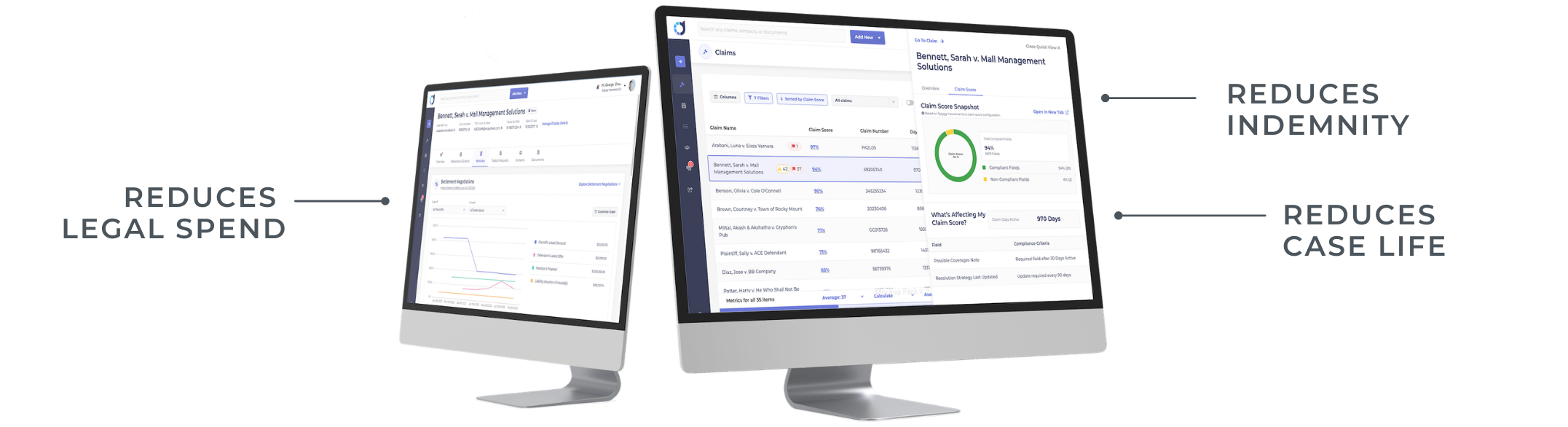
And when we looked at structured litigation processes through the Hermes Law Case Architectúra study, the results were hard to ignore:
15% reduction in indemnity
10% reduction in legal spend
200+ days shaved off average case life
Not by magic.
Not by AI fairy dust.
But by doing something radical in insurance:
👉 Making litigation visible while it’s happening.
This Isn’t About Monitoring Lawyers. It’s About Not Flying Blind.
Let’s clear something up.
Better litigation management isn’t about micromanaging counsel or turning claims into a surveillance exercise. It’s about:
Aligning strategy early
Making expectations explicit
Catching drift before it becomes cost
At ClaimDeck, we talk a lot about behavioral infrastructure, because data on its own doesn’t change outcomes. Feedback loops do.
That’s why features like Claim Score exist:
Not to punish, but to surface where guidelines, timelines, and strategy quietly fall apart.
Think less “Big Brother.”
More “GPS recalculating before you end up in a very expensive cul-de-sac.”

The Real ROI Isn’t Just Financial, It’s Cognitive
Yes, there’s ROI.
But the biggest shift we see isn’t just on spreadsheets, it’s in how teams think:
Adjusters regain confidence because they can see progress
Legal conversations become strategic instead of reactive
Claims leaders stop being surprised by outcomes they technically “owned”
Or, as Tim Violet put it perfectly in a recent piece:
If you change nothing, nothing will change.
Litigation is where that quote really earns its keep.
So… Why Does This Still Matter Now?
Because the market is at an inflection point.
Blueprint Two.
AI everywhere.
Data standards finally behaving themselves.
But AI doesn’t work on buried documents and vibes.
And predictive insight doesn’t come from inbox archaeology.
If litigation data isn’t structured, connected, and live, it doesn’t exist in any meaningful strategic sense.
And the carriers who figure this out early?
They won’t just reduce spend.
They’ll make better decisions faster, while everyone else is still asking for the latest update.
Final Thought (and a Slightly Blunt One)
If your litigation strategy lives in:
Outlook
Excel
And the phrase “we’ll look at it when the bill comes in”
Then you’re not managing litigation.
You’re funding it.
ClaimDeck exists to change that, not by replacing your ecosystem, but by finally giving litigation a proper seat at the digital table.
And honestly?
It’s been overdue since about 2009.

Learn how ClaimDeck helps carriers cut case life by 200+ days, reduce spend, and make litigation AI-ready.

ClaimDeck™ eliminates claims litigation leakage for carriers while driving process into the law firm, modernizing the litigation process.
Follow ClaimDeck on LinkedIn.